A step-by-step guide to catch up bookkeeping for small businesses before the 2027 filing season, with typical timelines, costs, and IRS record-keeping rules.
Quick answer
Catch-up bookkeeping means recording and reconciling every month you missed so your books are accurate and tax-ready. Gather your statements and receipts, reconcile the oldest month first, categorize every transaction, fix opening balances, then produce a profit and loss and balance sheet. Start now: clean books drive your Feb. 1, 2027 1099s and your Mar. 15 and Apr. 15, 2027 returns.
If you are behind on bookkeeping, it is fixable. The catch is time: every month you wait adds more transactions to sort out, and bookkeepers get busy in January.
Contents
- Catch-up vs. cleanup bookkeeping
- Signs you are behind on bookkeeping
- How to catch up, step by step
- How long catch-up takes
- How much catch-up bookkeeping costs
- The risks of filing on bad books
- How long to keep your records
- Month-end close checklist
- Denver and Houston considerations
- FAQ
Catch-up vs. cleanup bookkeeping: what’s the difference?
Catch-up bookkeeping means entering and reconciling past months that were never recorded, so your books are complete through today. Cleanup bookkeeping means fixing books that were entered but entered wrong: miscategorized expenses, duplicate transactions, personal spending mixed in, or accounts that were never reconciled.
Most projects are a mix of both. Either way, the goal is books that match your bank statements and that your tax preparer can trust.
A bookkeeper usually does this work, and your tax preparer uses the finished books. Not sure who handles what? Read the difference between a bookkeeper and an accountant.
Signs you are behind on bookkeeping
- Your last bank reconciliation was more than a month or two ago.
- The balance in your accounting software does not match your bank balance.
- You have a growing pile of uncategorized or “ask my accountant” transactions.
- You cannot say what your profit was last quarter without guessing.
- You do not know which contractors you paid $2,000 or more this year.
- A lender, landlord, or buyer asked for financial statements and you could not produce them quickly.
If two or more sound familiar, start now rather than in March.
How to catch up your books, step by step
Step 1: Gather your records
Collect these for every missing month and every business account:
- Bank statements for every checking and savings account
- Credit card statements, including any personal cards used for business
- Loan and line-of-credit statements that show the principal and interest split
- Payroll reports, quarterly payroll tax filings, and year-end W-2 summaries
- Card processor reports, sales tax returns, receipts, and invoices
- Last year’s tax return, including the balance sheet if your business files one
The IRS lists sales slips, paid bills, invoices, receipts, deposit slips, and canceled checks as the supporting documents behind your books in IRS Publication 583. Request any missing statements now; older ones can take time to arrive.
Step 2: Reconcile the oldest month first
Reconciling means matching every transaction in your books to the bank or card statement so the ending balances agree. Start with the earliest month that was not reconciled and work forward one month at a time. Each month’s ending balance becomes the next month’s starting balance, so an error left in February will throw off every month after it.
Step 3: Categorize every transaction
Assign each transaction to an account in your chart of accounts, the list of categories in your software. Watch for these mistakes:
- Loan payments: only the interest is an expense; the principal reduces the loan balance.
- Transfers: moving money between your own accounts is not income or an expense.
- Owner draws and personal spending: these are not business expenses.
- Meals: starting in 2026, meals provided for the employer’s convenience are not deductible, while client and travel meals are still 50% deductible. Keep them in separate accounts.
- Contractors: tag each contractor as a vendor so you can pull 1099 totals in January.
Step 4: Fix opening balances
The opening balance is the starting point of your books for the year. It should match the ending balances from last year’s books and tax return. A balance in an “opening balance equity” account usually means something was skipped. Agree on the starting numbers with your tax preparer before going further.
Step 5: Review payables and receivables
Accounts receivable is money customers owe you; accounts payable is bills you owe. Old invoices that were actually paid, or paid bills never recorded, distort your profit. Match both lists to real deposits and payments.
Step 6: Produce and review your financial statements
Run a profit and loss statement (income minus expenses for the period) and a balance sheet (what the business owns and owes on a given date). Loan balances should match lender statements, payroll expense should match payroll reports, and no account should show an odd negative balance. Then lock the closed months in your software.
How long catch-up bookkeeping takes
| How far behind | Typical timeline | What usually slows it down |
|---|---|---|
| 1 to 3 months | About 1 to 2 weeks | Missing receipts, unanswered questions |
| 4 to 6 months | About 2 to 4 weeks | Several accounts, payroll to match |
| 7 to 12 months | About 3 to 6 weeks | High transaction volume, mixed personal spending |
| More than a year | About 1 to 3 months or longer | Missing statements, unfiled returns, payroll or sales tax filings to correct |
These are typical ranges for a small business that has its statements on hand, not a promise. Transaction volume, the number of accounts, and how quickly you answer questions make the biggest difference.
Now do the deadline math. Forms 1099-NEC are due February 1, 2027, and you need clean vendor totals to file them. S corporation and partnership returns are due March 15, 2027, and owners need those K-1s to file their own returns by April 15, 2027. If you are ten months behind in November, a project of several weeks can run into December, and December itself still has to be recorded in January. Start now.
How much does catch up bookkeeping cost?
Catch-up work is usually quoted as a one-time project, separate from any monthly fee. The price depends on:
- How many months are behind
- Transaction volume during those months
- Whether bank and card statements are available
- Whether past tax returns, payroll filings, or sales tax returns also need fixing
A few months of catch-up for a simple service business can cost a few hundred dollars. A year or more of high-volume books with missing records can run into the thousands. Catch-up work usually costs more per month of history than ongoing monthly service, because nothing has been categorized and questions are harder to answer after the fact.
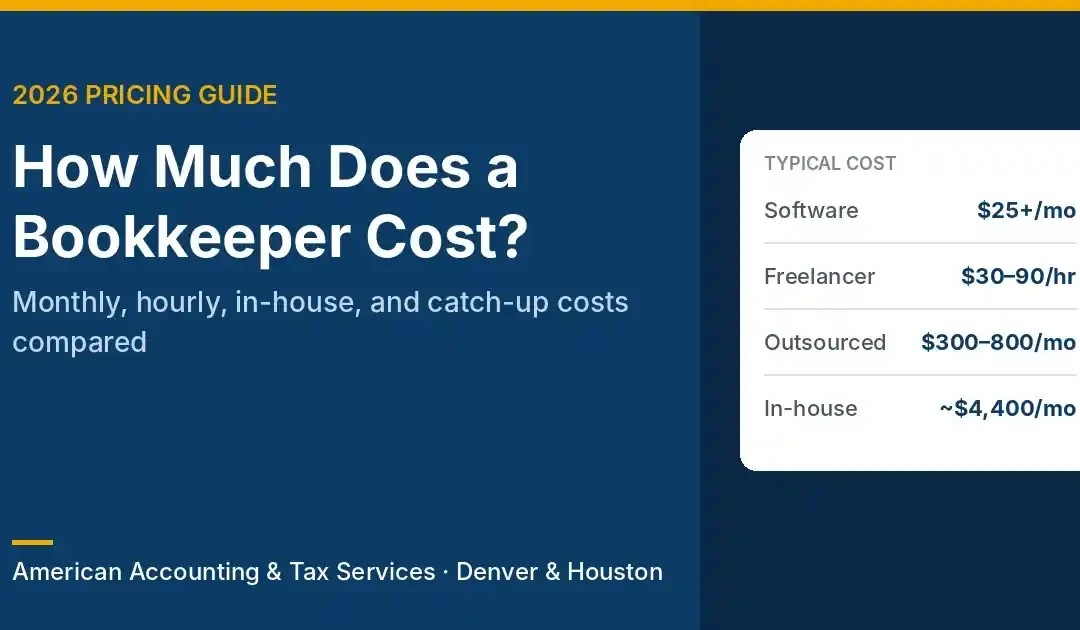
Once you are current, most small businesses pay about $300 to $800 a month for outsourced monthly bookkeeping, and freelance bookkeepers typically charge about $30 to $90 an hour. These are typical market ranges, not our price list. For a full breakdown, see how much a bookkeeper costs in 2026.
Behind on your books? Get current before 1099 season
Tell us how many months you’re behind and which accounts you use, and we’ll scope your catch-up project and quote it up front. Denver and Houston, in person or virtual.
The risks of filing on bad books
- Accuracy penalties. The IRS accuracy-related penalty is 20% of the underpayment caused by negligence or a substantial understatement of tax, plus interest.
- Late filing and late payment penalties. Filing late generally costs 5% of the unpaid tax for each month or partial month, up to 25%. Paying late adds 0.5% a month, also capped at 25%.
- Missed deductions. Expenses missing from the books never reach the return.
- 1099 errors. Wrong vendor totals mean incorrect or late information returns, which carry their own penalties.
Extension vs. accuracy
If your books won’t be ready, an extension usually beats filing on guesses. Individuals use Form 4868 to get until October 15 to file, and businesses use Form 7004 for an automatic six-month extension. But an extension gives you more time to file, not more time to pay. You still need to estimate and pay what you owe by the original deadline, and that estimate is only as good as your books.
How long to keep your records
The IRS says to keep records as long as they may be needed to support your return, which generally means until the period of limitations for that return runs out. Here is what Publication 583 and the IRS guide on how long to keep records list:
| Situation | Keep records for |
|---|---|
| Most income tax returns | 3 years after filing |
| You file a claim for credit or refund after filing | 3 years after filing or 2 years after paying the tax, whichever is later |
| Unreported income over 25% of the gross income on your return | 6 years |
| Loss from worthless securities or a bad debt deduction | 7 years |
| Employment tax records | At least 4 years after the tax is due or paid, whichever is later |
| Property and equipment records | Until the period of limitations ends for the year you sell or dispose of it |
| No return filed, or a fraudulent return | Indefinitely |
Returns filed early are treated as filed on the due date. Lenders and insurers may require you to keep records longer, so check before you shred anything.
Month-end close checklist to stay current
A month-end close is a short routine that finalizes one month’s books. Do it monthly and you won’t need another catch-up.
- ☐ Reconcile every bank, credit card, and loan account by a set date, such as the 10th
- ☐ Clear all uncategorized transactions
- ☐ Attach or scan receipts
- ☐ Record payroll and match it to your payroll provider’s reports
- ☐ Review unpaid customer invoices and follow up on late ones
- ☐ Enter and schedule all bills
- ☐ Collect a Form W-9 from each new contractor before the first payment
- ☐ Match sales tax collected to the returns you file
- ☐ Review the profit and loss and balance sheet
- ☐ Lock the closed month in your software
- ☐ Each quarter: check that estimated tax payments still cover what you owe
For more habits that keep the books healthy, see our top 10 tips for managing small business finances and the 2026 year-end tax planning checklist.
Catch-up bookkeeping in Denver and Houston
Denver and Colorado
Sales tax is often the hardest part of a Colorado catch-up. Denver and other home-rule cities administer their own sales tax on top of the state’s, so your books must match what you collected to each return you filed. Our Denver bookkeeping services team works from our office at 1880 Arapahoe St.
Houston and Texas
Texas has no personal income tax, but your books still feed the Texas franchise tax report, due May 17, 2027 this cycle because May 15 falls on a Saturday. Businesses with annualized total revenue of $2.65 million or less owe no franchise tax for 2026 and 2027 reports, but most still file an information report, and you need accurate revenue to know which side of the line you are on. See our Houston bookkeeping services.
Want help with ongoing books after the catch-up is done? Learn about our monthly bookkeeping services.
Frequently asked questions
What is the difference between catch-up and cleanup bookkeeping?
Catch-up bookkeeping records and reconciles months that were never entered. Cleanup bookkeeping fixes books that were entered incorrectly, such as miscategorized or duplicate transactions. Many projects need both.
How long does catch-up bookkeeping take?
A few months behind typically takes one to two weeks. A full year often takes three to six weeks, and more than a year can take one to three months or longer, depending on volume and missing records.
How much does catch up bookkeeping cost?
It is usually a one-time project fee based on how many months are behind and your transaction volume. A few months for a simple business may cost a few hundred dollars; a year or more of complex books can run into the thousands.
Can I file my taxes if my books are not up to date?
You can request an extension with Form 4868 for individuals or Form 7004 for businesses. That extends the time to file, not to pay, so you still need to estimate and pay any tax due by the original deadline.
How far back should I catch up my books?
Start from the last month your books were reconciled and matched a filed tax return. If you have unfiled returns, those years need to be caught up too.
Sources: IRS Publication 583, Starting a Business and Keeping Records (Rev. December 2024); IRS, How long should I keep records; IRS failure to file, failure to pay, and accuracy-related penalty guidance; IRS, Get an extension to file your tax return, and About Form 7004; IRS Instructions for Forms 1099-MISC and 1099-NEC; Texas Comptroller, franchise tax; published 2026 small business bookkeeping pricing surveys. Timelines and prices vary by provider and scope. This article is general information, not accounting advice for your situation.