Quick answer
Outsourced bookkeeping means hiring an outside firm to record your transactions, reconcile your accounts, and produce monthly financial statements. Most small businesses pay about $300 to $800 a month for it, compared with roughly $54,500 a year in wages and payroll taxes for a full-time employee at the national median, before benefits. Outsourcing also removes the risk of one person leaving with all the knowledge and puts your books in front of a team that double-checks the work. In-house bookkeeping makes more sense once your transaction volume is high enough to keep someone busy full time, or when someone has to be on site every day.
Contents
- What an outsourced bookkeeper does
- Outsourced vs. in-house at a glance
- What each option costs
- 7 benefits of outsourcing
- Downsides and how to manage them
- How the switch works
- How to choose a firm
- Signs it’s time to outsource
- When in-house makes sense
- FAQ
What is bookkeeping, and what does an outsourced bookkeeper do?
Bookkeeping is the day-to-day recording of a business’s financial transactions: sales, purchases, payments, and receipts. Good bookkeeping means every dollar in and out is categorized and matched to a bank statement. Your tax returns, loan applications, and business decisions all depend on those records.
An outsourced bookkeeper does that work for you, usually remotely in cloud accounting software such as QuickBooks Online or Xero. A typical monthly service covers:
- Recording and categorizing income and expenses
- Reconciling bank, credit card, and loan accounts every month
- Managing accounts payable and accounts receivable
- Preparing a monthly profit and loss statement and balance sheet
- Coordinating with payroll and sales tax filings
- Giving your tax preparer clean, year-end-ready books
Bookkeeping is not the same as accounting. A bookkeeper keeps the records accurate and current; an accountant analyzes them, prepares tax returns, and advises on strategy (see bookkeeper vs. accountant for the full comparison). Many firms, including ours, offer both, so the person preparing your return already knows your books.
Outsourced vs. in-house bookkeeping at a glance
| Factor | Outsourced | In-house employee |
|---|---|---|
| Cost | A monthly fee that scales with your volume | Salary plus payroll taxes, benefits, training, and software |
| Expertise | A team with experience across many industries | Limited to one person’s skills |
| Quality control | Work is reviewed by a second person | Often no independent review |
| Continuity | No disruption when someone is sick or leaves | Books can stall if the employee leaves |
| Fraud protection | Separates who spends money from who records it | One person may control both |
| On-site availability | Remote, with scheduled check-ins | In the office daily |
What outsourced and in-house bookkeeping cost
Cost is usually the deciding factor, and the gap is larger than most owners expect, because an employee costs much more than a salary.
| Option | Typical cost |
|---|---|
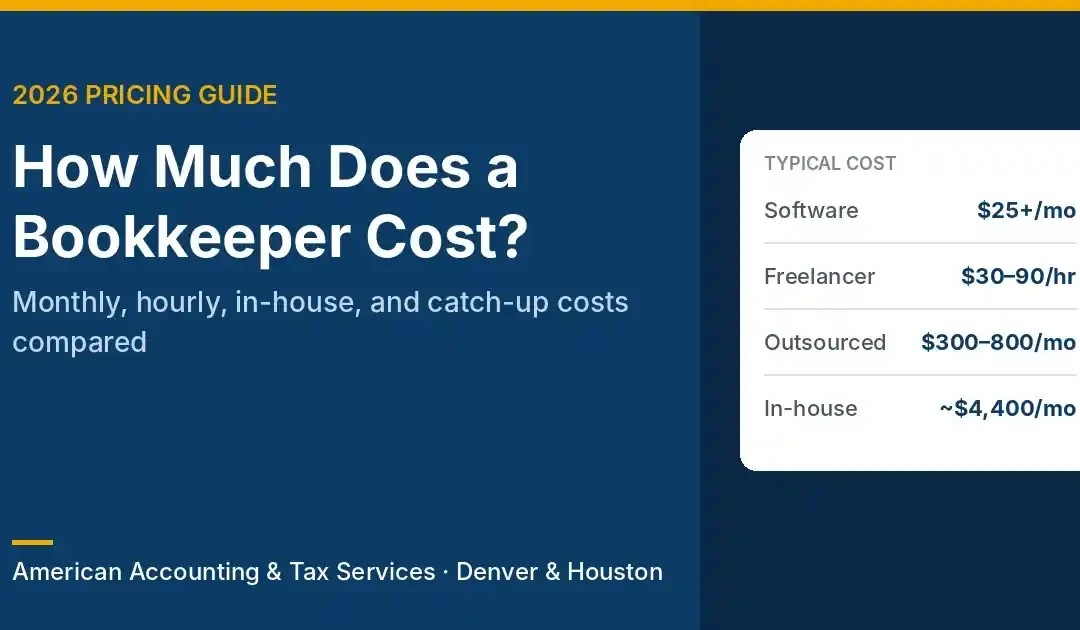
| Do it yourself with software | About $25–$275 a month for software, plus your time |
| Freelance bookkeeper | About $30–$90 an hour |
| Outsourced bookkeeping firm | About $300–$800 a month for most small businesses; more with payroll, inventory, or high volume |
| Full-time in-house bookkeeper | $50,670 median wage plus 7.65% employer payroll tax, or about $54,500 a year before benefits |
Ranges are typical market figures, not our price list. Wage data: U.S. Bureau of Labor Statistics median annual wage for bookkeeping, accounting, and auditing clerks (May 2025). Wages in the Denver and Houston metro areas can run above the national median.
A worked example
Say a service business has about 150 transactions a month across two bank accounts and one credit card, plus payroll for five employees. A full-time bookkeeper would cost roughly $54,500 a year before health insurance, paid time off, and software, yet the work might fill only 10 to 15 hours a week. An outsourced service priced near the upper end of the typical range, about $800 a month, comes to $9,600 a year. Even with a one-time catch-up fee in the first year, the owner keeps most of the difference and gets reviewed, on-time monthly statements.
Fees for bookkeeping and accounting services are generally deductible business expenses, which lowers the real cost further. Our guide to reducing taxable income covers other deductions owners miss.
Why outsource bookkeeping? 7 benefits
1. Lower overhead
An employee costs more than a salary. You also pay payroll taxes, benefits, paid time off, training, and software licenses. With outsourced bookkeeping, you pay for the work your business actually needs.
2. More time to run the business
Owners who do their own books often spend hours each month on data entry and reconciliation. Outsourcing gives that time back for sales, customers, and growth.
3. A team instead of one person
A firm assigns your books to trained staff and has their work reviewed. Mistakes get caught before they become tax problems.
4. Continuity when people leave
When an in-house bookkeeper quits, the books can fall months behind (here is how to get them current again). An outside firm keeps working, and your records stay documented.
5. Better fraud protection
Embezzlement often happens when one person controls both payments and records. An outside bookkeeper adds a separation of duties and flags unusual transactions.
6. Better information for decisions
Monthly financial statements show which services make money, where cash goes, and whether you can afford to hire. That’s hard to see when the books are months behind. Our guide to managing small business finances shows how to use those reports each month.
7. Easy to scale
As you add locations, employees, or sales channels, an outsourced service grows with you without a new hire.
Downsides of outsourcing, and how to manage them
Outsourcing isn’t right for every business, and it works best when you plan for its trade-offs.
- No one on site. A remote bookkeeper can’t collect paper receipts or count the cash drawer. Use receipt-capture apps and bank feeds, and keep one person in-house responsible for cash handling.
- Response time. A firm serves many clients. Agree on response times and a monthly close date in writing, for example books closed and reports delivered by the 15th of the following month.
- Data access. You’ll share access to your accounting software and bank feeds. Give user-level access rather than your own login, use read-only bank connections where possible, and turn on two-factor authentication.
- Onboarding effort. The first month takes time: account access, a review of your chart of accounts, and possibly cleanup. After that, most owners spend far less time on the books than before.
- Scope surprises. Payroll, sales tax filings, bill pay, and catch-up work may be priced separately. Get the scope in writing before you sign.
How the switch to outsourced bookkeeping works
- Scope call. The firm reviews your transaction volume, accounts, payroll, sales tax, and reporting needs, then quotes a monthly fee.
- Access. You add the firm as a user in your accounting software and connect bank and credit card feeds.
- Cleanup, if needed. If the books are behind or messy, the firm catches them up first, usually as a one-time project.
- Monthly close calendar. You agree on a schedule: when you send receipts and questions are answered, and when reconciled statements are delivered.
- Monthly review. You get a profit and loss statement and balance sheet each month, with a short call or email to explain anything unusual.
- Year-end handoff. At year end, your tax preparer gets reconciled books instead of a shoebox, which usually shortens tax season and lowers the cleanup bill.
How to choose an outsourced bookkeeping firm
Look for a firm that can answer yes to most of these:
- Works in your accounting software every day, such as QuickBooks Online or Xero
- Has every month reviewed by a second person before reports go out
- Commits to a monthly close date and a response time
- Prices transparently, with payroll, sales tax, and catch-up work clearly listed
- Coordinates with your tax preparer, or prepares your return itself
- Knows your state and city rules. In Denver, sales tax is filed directly with the city, separately from Colorado, because Denver is a home-rule city. In Texas, businesses file sales tax with the Comptroller and an annual franchise tax report.
- Uses secure, role-based access and never asks for your personal banking password
If you’d rather hire someone yourself, our 8-step checklist for hiring a bookkeeper covers interview questions and red flags.
Ready to hand off your books?
American Accounting & Tax Services provides monthly bookkeeping for small businesses in Denver, Houston, and beyond.
Signs it’s time to outsource your bookkeeping
- Your books are more than one month behind.
- Your tax preparer has to clean up your records every year.
- You don’t know your profit until tax time.
- You or a family member spend more than a few hours a week on the books.
- You’ve missed a sales tax or payroll deadline.
- You’re applying for a loan or bringing on investors and need reliable financial statements.
When in-house bookkeeping makes sense
A full-time bookkeeper can make sense when your volume is high enough to fill a full workload, or when someone needs to be on site daily for tasks like handling cash, receiving inventory, or chasing invoices in person.
Many growing companies use a hybrid model: an in-house clerk handles daily entry and bill pay, and an outside firm reviews the books, closes each month, and prepares tax returns. That keeps a second set of eyes on the numbers without paying for a full accounting department.
Frequently asked questions
How much does outsourced bookkeeping cost?
Most small businesses pay about $300 to $800 a month. Pricing depends on how many transactions and accounts you have, whether payroll or inventory is involved, and how often you need reports. See how much a bookkeeper costs in 2026 for a full breakdown, or contact us for a quote based on your volume.
Is outsourced bookkeeping secure?
Reputable firms use cloud accounting software with role-based access, so you control who can see and change your data, and you can see your books at any time.
Will I lose control of my finances?
No. You still approve payments and make decisions. You’ll actually have more visibility, because the books are current and reported monthly.
How long does it take to switch to an outsourced bookkeeper?
Setup usually takes a few weeks: granting access, connecting bank feeds, and reviewing your chart of accounts. If your books are behind, a catch-up project comes first.
Can an outsourced bookkeeper handle payroll and sales tax?
Often, yes. Many firms run payroll and file sales tax returns, or coordinate with your payroll provider. Confirm which filings are included in the monthly fee.
What’s the difference between a bookkeeper and an accountant?
A bookkeeper records and reconciles transactions. An accountant analyzes those records, prepares tax returns, and advises on strategy. Learn about our accounting services.
Sources: U.S. Bureau of Labor Statistics, Occupational Outlook Handbook, Bookkeeping, Accounting, and Auditing Clerks; IRS Publication 15 (employer Social Security and Medicare tax rates); City and County of Denver, Business Tax FAQ; Texas Comptroller of Public Accounts. Prices vary by provider and scope. More guides: bookkeeping and all small business tax and accounting tips.