A plain-English bookkeeper vs accountant guide for small business owners in Denver and Houston, including where CPAs and enrolled agents fit.
Quick answer
A bookkeeper records and reconciles your day-to-day transactions, while an accountant interprets those records to file taxes, plan, and advise. Outsourced bookkeeping typically runs about $300 to $800 a month. Most growing small businesses need both: a bookkeeper every month and a CPA or enrolled agent for taxes, since only CPAs, enrolled agents, and attorneys have unlimited IRS representation rights.
Contents
- The difference between a bookkeeper and an accountant
- Bookkeeper vs accountant: side-by-side comparison
- What each one actually does
- Accountant vs CPA vs enrolled agent
- What each one costs
- Do I need a bookkeeper or an accountant?
- How they work together through the year
- When a Denver or Houston business needs both
- Checklist for hiring the right help
- Frequently asked questions
The difference between a bookkeeper and an accountant
The simplest way to think about it: a bookkeeper keeps the record, and an accountant uses the record.
A bookkeeper is the person who records every sale, bill, and payment in your accounting software and makes sure the books match your bank and credit card statements. The work is ongoing, detailed, and usually done weekly or monthly.
An accountant is a finance professional who reviews those records, prepares financial statements and tax returns, and helps you make decisions about taxes, cash flow, and growth. Accounting work is more periodic and more advisory.
The jobs overlap, but the training, price, and what each can legally do for you with the IRS are different.
Bookkeeper vs accountant: side-by-side comparison
“Accountant” is a broad title, so the table splits it into the three types you are most likely to hire.
| Compare | Bookkeeper | Accountant | CPA | Enrolled agent (EA) |
|---|---|---|---|---|
| Main job | Records transactions, reconciles accounts, runs basic reports | Reviews the books, prepares financial statements and returns, advises | Everything an accountant does, plus audits, reviews, and complex tax work | Tax specialist: returns, tax planning, and IRS problems |
| Credentials | No license required; certification is optional | Usually a bachelor’s degree in accounting; no license required for most work | Passed the Uniform CPA Exam; licensed by a state board of accountancy | Licensed by the IRS after a three-part exam and suitability check |
| Typical cost | About $300–$800/month outsourced; about $30–$90/hour freelance | Hourly, per project, or monthly retainer, at higher rates than bookkeeping | Usually priced per engagement; generally the highest rates of the four | Usually priced per return or per engagement |
| When you need them | Every month, from the first sale | Quarterly reviews, year-end, financing, big decisions | Audited or reviewed statements, complex tax, lender or investor reporting | Business and personal returns, IRS notices, audits, payment plans |
| Can prepare your tax return? | Only with an IRS preparer tax ID (PTIN); most don’t | Yes, with a PTIN | Yes | Yes |
| Can represent you before the IRS? | No (limited rights only through the IRS Annual Filing Season Program) | No, unless also a CPA, EA, or attorney (limited rights through the same program) | Yes, unlimited | Yes, unlimited |
Cost ranges are typical market figures for 2026, not our price list. Bookkeeping ranges match our guide to how much a bookkeeper costs.
What each one actually does
What a bookkeeper does
- Records sales, expenses, and payments in your accounting software
- Categorizes transactions so deductions are not missed
- Reconciles bank, credit card, and loan accounts every month. Reconciling means matching your books to the bank’s records line by line.
- Tracks who owes you money (accounts receivable) and who you owe (accounts payable)
- Often runs payroll and collects W-9s from contractors
- Produces a monthly profit and loss statement and balance sheet
What an accountant does
- Reviews the books for errors and makes year-end adjustments
- Prepares financial statements for lenders, investors, or buyers
- Prepares business and personal tax returns
- Plans taxes: entity choice, owner pay, estimated payments, and timing of big purchases
- Builds budgets, cash flow forecasts, and profitability analysis
- Answers the “should we?” questions: hire, buy, borrow, or expand
Put simply, bookkeeping looks back at what happened. Accounting uses that history to look ahead.
Accountant vs CPA vs enrolled agent
In most situations, anyone can call themselves an accountant. The titles that carry legal weight are CPA and enrolled agent.
Certified public accountant (CPA)
A CPA is an accountant who has passed the Uniform CPA Examination and met education, experience, and character requirements set by a state board of accountancy. In Colorado that is the Colorado State Board of Accountancy; in Texas, the Texas State Board of Public Accountancy. CPAs are the only professionals who can perform audits and issue audited financial statements. They handle tax work too, but many specialize in audit, advisory, or industry niches.
Enrolled agent (EA)
An enrolled agent is a tax professional licensed directly by the IRS. According to the IRS, enrolled agents must pass a suitability check and a three-part Special Enrollment Examination covering individual and business returns, tax planning, and representation, then complete 72 hours of continuing education every three years. If your main need is tax returns and IRS issues, an EA is a strong fit.
Why representation rights matter
Representation rights are your preparer’s legal authority to deal with the IRS for you. The IRS is clear on this: only enrolled agents, CPAs, and attorneys have unlimited representation rights. They can represent you in audits, payment and collection issues, and appeals.
Other paid preparers have much less. Preparers in the IRS Annual Filing Season Program can represent you only during an examination of a return they prepared, and not in appeals or collections. Preparers with just a PTIN have no representation rights for current returns at all. So if a bookkeeper or uncredentialed accountant does your return and you get audited, you may need to hire someone else mid-audit.
What each one costs
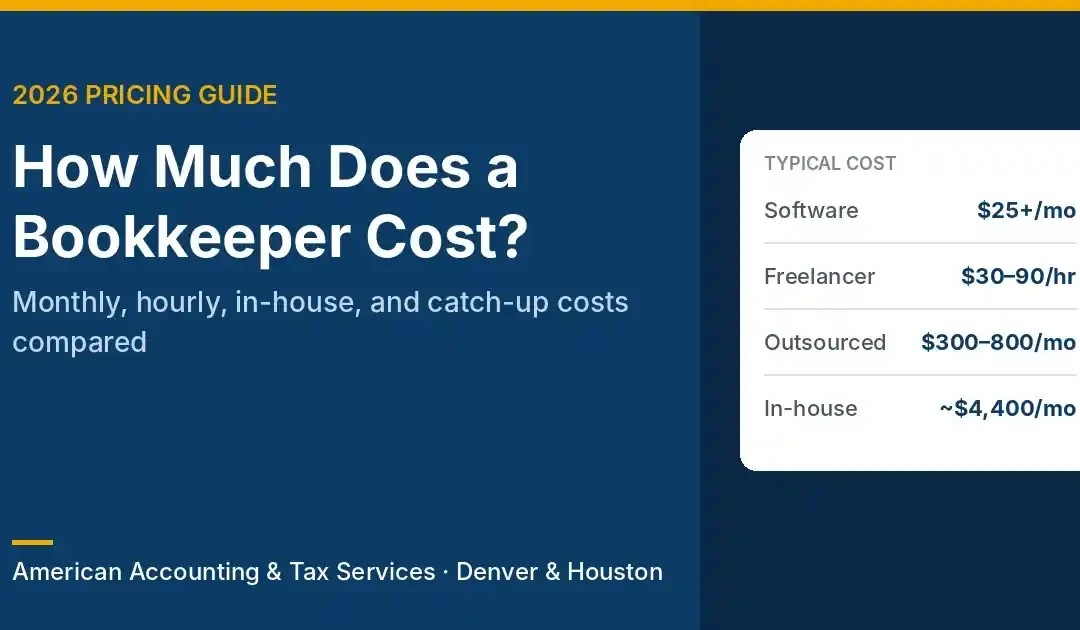
For bookkeeping, most small businesses pay about $300 to $800 a month for an outsourced service, or about $30 to $90 an hour for a freelancer. Businesses with payroll, inventory, or heavy transaction volume pay more.
Hiring in-house costs far more. According to the U.S. Bureau of Labor Statistics, the median annual wage was $50,670 for bookkeeping, accounting, and auditing clerks (May 2025) and $83,680 for accountants and auditors (May 2025). Add employer payroll taxes and benefits on top. Denver-area wages tend to run above the national median.
Outside accountants, CPAs, and EAs usually price by the project (a tax return, a set of financial statements) or by a monthly or quarterly retainer that bundles tax planning. Hourly rates are higher than bookkeeping because the work needs more training and carries more liability.
The cost trap to avoid: paying accountant rates for bookkeeping work. If your accountant spends February sorting a year of uncategorized transactions, you are paying a premium for data entry. Clean monthly books almost always lower your tax-prep bill.
Get bookkeeping and tax help under one roof
Tell us where your books stand and what you need at tax time, and we’ll recommend the right mix of monthly bookkeeping and accounting. Serving small businesses in Denver, Houston, and beyond.
Do I need a bookkeeper or an accountant?
Most businesses need a bookkeeper first and an accountant soon after. Use these signs to decide where you are.
Signs you need a bookkeeper
- You are more than a month behind on categorizing transactions
- You can’t say what your profit was last month without guessing
- Bank and card accounts have never been reconciled
- You are mixing personal and business spending
- You are spending more than a few hours a month on the books yourself
- You hired your first employee or started paying contractors
Signs you need an accountant
- You owe estimated taxes and aren’t sure how much to pay
- Your profit has grown and you are asking about an S corporation election
- A lender, landlord, or investor wants financial statements
- You got an IRS or state tax notice (see what a CP2000 letter means)
- You are buying equipment, a vehicle, or another business
If you checked items on both lists, you need both. That is normal once a business has steady revenue and employees.
How they work together through the year
When the two are coordinated, each makes the other cheaper and more accurate. Here is a typical year for the 2026 tax year:
- Every month: Your bookkeeper categorizes transactions, reconciles accounts, and closes the books by a set date.
- Every quarter: Your accountant reviews the numbers and sets quarterly estimated tax payments. The fourth-quarter 2026 payment is due January 15, 2027.
- October to December: Your accountant runs year-end tax planning using books your bookkeeper has kept current.
- January: Your bookkeeper confirms contractor totals. For payments made in 2026, Form 1099-NEC is required for contractors paid $2,000 or more, and it is due February 1, 2027.
- February to April: Your bookkeeper hands over a year-end package. Your accountant prepares returns due March 15, 2027 (S corporations and partnerships) and April 15, 2027 (individuals and C corporations).
The handoff is where most problems happen. Agree up front on who owns payroll filings, who issues 1099s, and what the year-end package includes. Our tax documents checklist is a good starting list.
When a Denver or Houston business needs both
Denver and Colorado
Colorado adds bookkeeping work that many owners underestimate. Denver and other home-rule cities administer their own sales tax on top of the state’s, so a business selling across the metro area may be tracking several sets of rules (our Denver and Colorado sales tax guide walks through the licenses and filings). Colorado also offers pass-through entities an elective entity-level tax under the SALT Parity Act, which needs accountant-level modeling before you elect. If you sell taxable goods in Denver or have partners or S corporation owners, you likely need both a bookkeeper and an accountant. Learn more about our Denver bookkeeping services.
Houston and Texas
Texas has no personal income tax, but it does have a franchise tax. For reports due in 2026 and 2027, businesses with annualized total revenue of $2.65 million or less owe no franchise tax, yet most still have to file an information report. The 2027 report is due May 17, 2027. Accurate revenue figures from your bookkeeper are what your accountant uses to file it. Houston businesses that collect sales tax also need clean monthly records to file on time. See our Houston bookkeeping services.
Checklist for hiring the right help
- ☐ Decide what you need: monthly books, tax returns, planning, or all three
- ☐ Ask a bookkeeper which software they use and how they reconcile accounts
- ☐ Confirm you keep your own login and can export your data at any time
- ☐ Ask a tax preparer for their PTIN and credential (CPA, EA, or attorney)
- ☐ Verify a CPA’s license with your state board, or check the IRS preparer directory
- ☐ Ask who represents you if you are audited
- ☐ Agree on who handles payroll filings, 1099s, and sales tax returns
- ☐ Get a written scope and a set monthly close date
For more on vetting candidates, read how to find a good bookkeeper and how to choose an accountant. When you are ready, compare our small business bookkeeping services, accounting services, and business tax services.
Frequently asked questions
Can a bookkeeper do my taxes?
Only if they have an IRS preparer tax identification number (PTIN), which every paid preparer needs. Even then, a bookkeeper who is not a CPA, enrolled agent, or attorney cannot fully represent you if the IRS audits that return. Most small businesses have the bookkeeper prepare the books and a credentialed preparer file the return.
What is the difference between an accountant and a CPA?
A CPA is an accountant who passed the Uniform CPA Exam and is licensed by a state board of accountancy. Every CPA is an accountant, but not every accountant is a CPA. Only CPAs can perform audits, and CPAs have unlimited representation rights before the IRS.
Is an enrolled agent as good as a CPA for taxes?
For tax returns and IRS issues, yes. Enrolled agents are licensed by the IRS, specialize in tax, and have the same unlimited representation rights as CPAs. Choose a CPA if you also need audited or reviewed financial statements.
Do I need a bookkeeper if I have an accountant?
Usually, yes. Accountants rely on accurate monthly books. Without a bookkeeper, you either do the books yourself or pay accountant rates for cleanup at tax time.
Can I do my own bookkeeping and hire an accountant only at tax time?
Yes, if your business is small and simple and you keep up every month. Once you add employees, inventory, sales tax, or several accounts, outsourcing the bookkeeping usually saves time and lowers your tax-prep bill.
Sources: IRS, Understanding Tax Return Preparer Credentials and Qualifications; IRS Enrolled Agent program; U.S. Bureau of Labor Statistics, Occupational Outlook Handbook, Accountants and Auditors (May 2025 wage data) and Bookkeeping, Accounting, and Auditing Clerks (May 2025 wage data); IRS Instructions for Forms 1099-MISC and 1099-NEC; Texas Comptroller, franchise tax; Colorado Department of Revenue, SALT Parity Act. Prices vary by provider and scope. This article is general information, not accounting or tax advice for your situation.